Overview
Emory College of Arts and Sciences combines the personal engagement and excellent teaching of a traditional liberal arts college with the ground-breaking scholarship and resources of a major research university. Our diverse, ethically engaged, and inquiry-driven community seeks to transform the world through leadership in research, teaching, and service. Our mission is supported by an internationally recognized faculty, dynamic staff, and superb facilities that adopt the latest innovations in technology and environmental sustainability. Emory College of Arts and Sciences continues to forge strong connections between its teaching and research missions, allowing for a learning experience like no other – one that is distinctive in its offerings and lasting in its effects. A vibrant liberal arts tradition is at the heart of every great academic institution, and the College believes its strengths will help propel Emory toward its future as a true destination university.
Emory College of Arts and Sciences offers 70 majors, 55 minors, and 17 joint concentrations. Nearly 40% of College students have some international experience by graduation, placing Emory among the top U.S. research universities for study abroad.Emory College faculty have published more than 750 books and have been distinguished recipients of the Pulitzer Prize, the National Humanities Medal, and the National Book Award. Through participation in interdisciplinary research centers across campus, College faculty bridge traditional barriers between the disciplines and work together to advance the frontiers of knowledge.
Read more about Emory’s first-rate students, faculty, and facilities.
Mission
As an institution dedicated to intellectual discovery and creativity, Emory College of Arts and Sciences is charged both with generating new knowledge and with inventing new ways of understanding what is already known. Faculty, administrators, and students cooperate to expand the boundaries of the known through research and experimentation, creation and performance, publishing the results of their efforts for the general advancement of learning and the betterment of the human prospect.
As a teaching institution, Emory College imparts to its students the kinds of knowledge that traditionally compose a broad liberal education: practical skills in critical thinking and persuasive writing, in mathematics and computation, in a foreign language; a basic familiarity with modes of inquiry proper to natural science and mathematics, to the social sciences, and to the arts and humanities; and a mature command of at least one discipline or field of concentration. Through instruction that aims to be the symbiotic complement of research, Emory College prepares its graduates to live an active life of the mind, aware of their responsibilities to assume a part in the intellectual leadership of the nation.
As an institution responsive to the various communities of which it is a member, Emory College acknowledges a commitment to service in its local community, in the national and international academic community, and in the nation as a whole.
Each aspect of this threefold mission must be carried forward in an atmosphere of intellectual and moral integrity, one of habitual regard for the ethical dimensions of research and creativity, teaching, and service.
Diversity
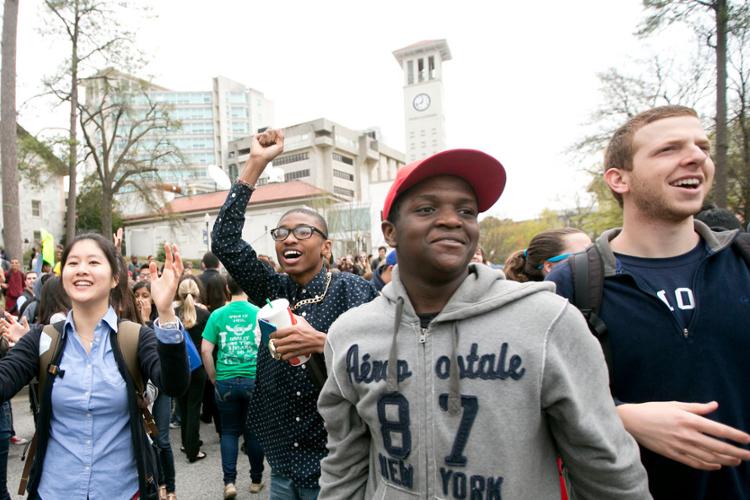
Emory College is committed to valuing difference and ensuring that the students, faculty, staff, and administrators are diverse in ethnicity, gender, religion, philosophy, sexual orientation, and physical ability. At the same time, we are unified in the goal of achieving academic excellence, preparing for life and work in a global society. We strive to offer multicultural and gender-balanced education in the curriculum, instruction, and services that address learning and physical disabilities and support for staff and faculty development.
History
Emory College of Arts and Sciences was founded in 1836 in Oxford, Georgia, and is the oldest college of the University. In 1915, Emory University was established in Atlanta with Emory College of Arts and Sciences as its undergraduate school of arts and sciences. College classes continued to be held at Oxford until 1919 when the college relocated to the new campus in Atlanta.
Read more about the history of Emory College of Arts and Sciences and Emory University.
Administrative Offices
The Administrative Offices manage the faculty appointments, human resources, budgeting, and facilities for the academic departments and programs of Emory College of Arts and Sciences.
Candler Library, Suite 400
Atlanta, Georgia 30322
ph. 404-727-6062
fx. 404-712-9451
college@emory.edu
Office of Undergraduate Education
The Office of Undergraduate Education provides academic support and programs for the students of Emory College of Arts and Sciences.
White Hall, Suite 300
Atlanta, Georgia 30322
ph. 404-727-6069
fx. 404-727-0638
college@emory.edu